

The Seven Hermetic Principles and Their Contemporary Uses
 There are many parts to the complex puzzle of life. It is as if you have suddenly been handed an ancient key that opens everything. The seven Hermetic principles, originally established by Hermes Trismegistus, can sometimes be quite difficult. But there is one idea behind them. This will be the core of the utilitarian principles.
It’s not flashy fireworks, but rather flexible building blocks that are full of assorted parts that can be taken and used for other purposes in reality. So, who is Hermes Trismegistus? He is a myth, half human, half Greek god, and half Egyptian god (Hermes and Thoth).
Both represent human wisdom. The principles he presents are not commandments or rules. They are guidelines that help us, as beings not so different from primitive humans, solve our problems about what to do. Before you scoff at the wisdom of the ancients, consider that the most basic features of our civilization, gravity, electricity, and everything else we have are the principles that they fulfill.
These principles existed long before humans knew how to manipulate them. There is no doubt that thousands of years of knowledge are waiting to be discovered.
The Principle of Mentalism
“The All is Mind; the Universe is Mental.”
This first axiom is intensely experienced because everything begins with the mind, that is, reality. It is not a collection of atoms or molecules but a manifestation of consciousness. Think of the universe as a beautiful dream. But who is daydreaming? Spoiler alert: it is you.
We have all experienced it. Imagine that sweet feeling when Monday morning comes too early, and your heart aches. You barely wake up, you are already stuck in traffic before your alarm goes off, and at 10 a.m., the barista pours you a cup of coffee on your lap, and your boss drops a “surprise” task that you did not ask for. And the tempo of that routine is completely reversed. Is it a coincidence or a mental illusion?
Think of creativity and sports. Think of your legs sprinting toward the finish line or shooting a three-pointer, and your brain and body are united in an excellent performance. It means that peak performance in sports for example is not just physical; it’s a mix of both mind and body.
The Correspondence Principle
“As above, so below; as below, so above.”
 This is the cosmic mirror effect. Another dimension of reality reflects your image. (Metaphorically speaking, the macroscopic world is the microscopic world. The swirls of galaxies are not much different from the swirls of a coffee cup. Isn’t that amazing?
This is a principle that works in many ways every day. Small habits bring us back to our daily routines. Have you ever felt comforted when you cleared your cluttered desk? When you are in harmony with your inner self, you feel the flow of your surroundings. Life becomes smoother.
Technology is the best example of what I mean. Through behavioral analysis algorithms, we observe that social networks function in a manner very similar to natural systems. Nature is engraved with patterns, large and small. What is the common principle behind it? It is the software that quietly sits beneath everything, driving all systems.
The Principle of Oscillation
“Nothing is still. Everything is moving, everything is ‘It vibrates.'”
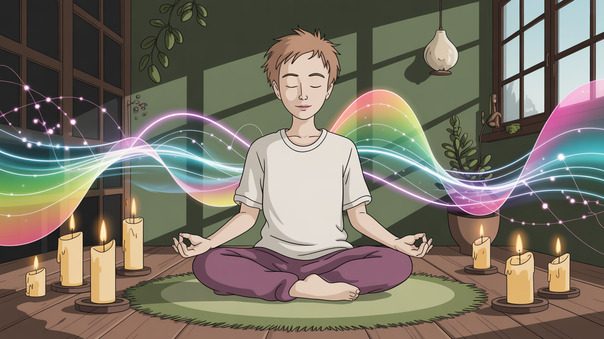
Imagine yogis chanting “Om” in the lotus position. The sound creates vibrations. Or, consider the fundamental truth that everything is in motion. If you look through a microscope, you can see atoms wobbling. And, even worse, the Earth is spinning like a dizzying top in a vast void. Even when it is perfectly still, there is motion.
You don’t necessarily need a scientific diagram showing the flow of energy to understand the flow of energy. Have you ever “felt” that something was wrong? Or have you ever had something go wrong, and no one mentioned it? Ultimately, that is what we perceive as vibration. We tune into frequencies that we cannot see or hear.
Want to raise your vibration? In order to do this, you must surround yourself with things that make you happy and do things that make you feel good. And listen to great music, and look at beautiful places, and laugh until you can’t breathe. You speak better when you are happy. This will ultimately form the basis of how you relate to the world.
The Principle of Polarity
“Everything is double; everything is two.”
 I began to understand that life is never neutral. For every positive, there is a negative, and the same goes for life, love, hate, warmth and cold, light and shadow. As I said, there’s always a pendulum swinging between these philosophies.
This has nothing to do with inductive reasoning. Inductive reasoning assumes that if you stand on one side, the other side is losing. Polarity is freedom, and it tempts you to see the gray areas on either side. Is failure good, or does it lead to the next success? When you sort through your most horrible emotions, you’re more likely to discover hidden lessons.
Let me tell you a fascinating story of one of my friends. My friend lost his small business and went bankrupt. But he found his true calling in another field, and that failure was to change the direction of his career. For him, this was not the end. It was the beginning of everything. And who knows what happens when a person starts? That’s what failure is all about.
The Principle of Rhythm
“Everything is always flowing; everything has its tides.”
Need help with rhythm? Look at the ocean. The tide comes and goes every now and then, but the next day the waves will still be crashing against the shore. Life has patterns to follow, like seasons and your energy. One moment you are a squirrel gathering nuts for the long winter, and the next moment something else appears.
Surfing can teach you to keep a steady beat. You can’t stop life, but a routine and rhythm helps you keep up. For example, if the stock market is going up, go along with it. Shouting in the rain is worse than fighting the rhythm. It’s pointless. Go with the flow instead of resisting.
This is also a sure sign of good self-care. Just as a plant doesn’t need to bloom, you don’t need to be at your best 24/7. We know when to push and when to rest, and our bodies deserve a break. Speaking of rest, don’t forget to drink water every now and then.
The Principle of Causality
“Every effect has a cause, and every cause has an effect.”
 It seems simple on the surface, but it is much more complicated. Nothing happens without a cause. The reason may be right in front of you.
People wake up in the morning and find themselves running along an unfamiliar road. Stop for a moment and think about how your day went. Maybe you skipped breakfast and realized you were really “hungry.” Or maybe you were mean to a naive and strong person and were fooled into thinking he would do you a favor later.
Life is complicated, but it is much easier to understand when you look at it from this perspective. But when it comes to things that inevitably happen, the most important thing is your reaction.
Meaning comes from causes, but it is not only causes that form meanings. There are other ways as well. We react to the choices we make. You are also a product of circumstances, but you determine the direction. Like the seeds you plant, what you cherish only grows.
The Principle of Gender
“Gender exists in everything. There is a masculine principle and a feminine principle in everything.”
This is not biological. In the realm of gender, the Hermetic perspective suggests two creative forces that exist in all things. Yang, the active masculine energy, is about moving ahead with action and reason whereas the feminine principle is soft and caring; you trust your hunches when necessary. In this way, both elements form one whole which is smoothly running and in balance.
Take brainstorming as an example. In the idea generation phase, you use your “feminine” nature, and in the action-oriented phase, you use your “masculine” nature. These two energies, inherent in the feminine and masculine archetypes, are inherent in almost everything we do.
Final Thoughts
 What does this mean for us today? Why should we go back to principles that were formed hundreds of years ago? If we delve deep into human situational awareness, they can be eerily accurate. The mentalist perspective, which emphasizes the mind over the body, is closely following the mindfulness and neuroplasticity concept. Bipolarity is a way of embracing contradiction rather than relying on the world’s overly dichotomous divisions. Finally, we all know that small decisions can have significant consequences.
However, that doesn’t mean that they necessarily have good morals or that they set clear boundaries. These principles are flexible and explanatory, and of course, you can use them however you want. You’ll like some of them, and you’ll dislike some of them. Either way, it’s fun to experiment with all of them.
Conclusion
It may seem old-fashioned, but the Seven Hermetic Principles contain as much wisdom for anyone walking the path today as they did when they were formulated in the 19th century. The question of existence will always be a part of life. Today, we constantly solve problems through past experiences. These principles are very helpful and should be followed in the right frame of mind! These criteria will bring a smile to your face when the world presents you with problems.
The universe may be mysterious, but with these seven keys, your future need not be mysterious. You see, when you can determine who has the pieces of the puzzle, life is never dull.

Leave A Comment