

Lessons from “Autobiography of a Yogi” by Paramahansa Yogananda
 Have you ever wondered if there is more to life than meets the eye? Yogananda kept this wonder in his heart all his life. In his book Autobiography of a Yogi, we glimpse his extraordinary journey from a book-reading boy in India to a college lecturer without a college degree, to spreading yoga and meditation to many in the West.
In his free time, he helped people solve problems and learn about successful living.
In Search of Something Deeper
Born in northern India in 1893, Yogananda had a longing for God since childhood. Yogananda had no interest in work or marriage, unlike other children his age. His purpose in life was much deeper.
One day, as a teenager, he left home to find his guru, or spiritual teacher. Something unseen told him that he was destined to meet his guru, but things did not go as planned. After meeting a saint far from his destination and having an unsatisfactory experience, he returned home frustrated. Life teaches us that timing is everything. Years later, when Yogananda met his guru, Sri Yukteswar, he immediately recognized him in his welcome. Sri Yukteswar told him, “I have been waiting for you for a long time.” This shows that what we seek can come to us when we least expect it.
The Power of a True Guru
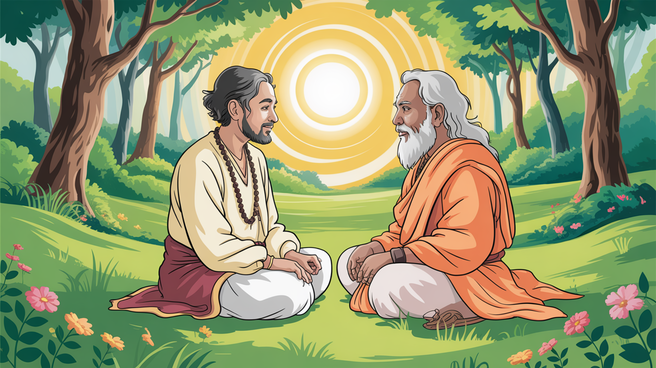 Sri Yukteswar instructed Yogananda that a true guru does not just pass on information, but brings about deep-seated inner transformation. Sri Yukteswar treated Yogananda with great kindness and at the same time, severity. He pointed out his mistakes in a forthright manner, and this lifted Yogananda’s self-respect.
One day, it was very hot and Yogananda felt proud of himself for not eating even one spoonful of his favorite ice cream. When he proudly reported to his guru, Sri Yukteswar, his own triumph, and then waited tentatively for his praise, Sri Yukteswar only peered at him ironically from the corners of his eyes—“Ha!” he said with a sneer, “You thought it wasn’t worthwhile to make the effort.” Yogananda’s self-respect was shaken by this sarcastic reply; it was, in fact, overturned!
Thus, the willingness to accept what we do not want to hear, the desire to recognize our own shortcomings, though encouraged by another who loves and cares for us, is not just useful in some cases; it may become essential. It makes us true Men of Growth. This attitude shows that there are no simple answers or magical formulas for actual personal growth. We all have to work hard at identifying our own problems and faults. And we find our answers amid those who care deeply about us.
Science and Spirituality Can Go Together
Unlike other religious leaders, who viewed science and spirituality as flatly opposed to each other, Yogananda saw these domains as allies in the search for Truth. To him, science was “the science of religion,” explaining how ancient yoga wisdom could provide an understanding of realities that modern science was only beginning to come close to grasping.
The great American botanist, Luther Burbank, impressed Yogananda deeply when they met, the way he spoke lovingly to plants. This fusion of a scientific world view with an attitude towards life that shows reverence made Yogananda appreciate how much Western science and Eastern religion could contribute to each other.
Is there a lesson in this for us today? We do not have to choose between science and religion.
Encounters with Extraordinary Yogis
 One of the most impressive parts of the book is Yogananda’s encounters with yogis with superhuman abilities. Yogananda tells of his encounter with Baduri Mahasaya, the “floating saint” who could sit cross-legged in midair.
Then comes “Tiger Swami,” who incurred the wrath of a Bengal tiger but later embraced the yogi’s serene life. Even more amazing is the fact that Giri Bala lived for over 50 years without food or drink, consuming what he called “spiritual energy.”
Yogananda still presents these seemingly fantastical stories as evidence that yoga can give us extraordinary powers. The point is not to find that power, but to realize that it lies dormant within us all, waiting to be unleashed and harnessed.
Meditation: A Multifunctional Tool
Unlike most yoga teachers, Yogananda did not teach meditation as a mystical ritual. It was wisdom. He introduced a special technique called Kriya Yoga to America, which he believed could be used to improve the brain through regular practice. He gave a public lecture on changing even your life, including reconstructing, calming emotions, and reversing aging.
Not having left himself any time to prepare for an important college exam, he suddenly realized that he could solve this problem by meditation just before the test started. Almost immediately after the test began, he felt a strange sensation down his spine. To his surprise, all the answers came into his head. Deep in thought, he passed the exam with honors.
The Lesson of Meditation
What is the lesson? Meditation is not just something you do; it is a disciplined way of going into the most developed and deepest part of your consciousness and drawing something out of it.
A Kinder and Faster Evolution
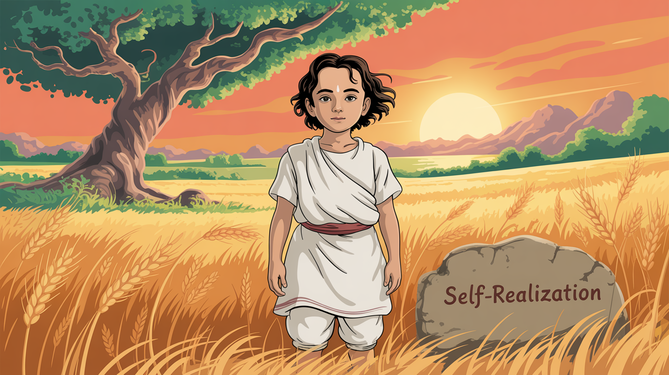 Yogananda would have called most of these events miracles. But Yogananda saw them not as crimes against nature, but as evidence of how nature is breaking down boundaries that have not yet been discovered.
Yogananda was traveling with his friends in Kashmir, without money to buy food, and he was hungry. He prayed quietly. Then one day, a stranger stopped them and gave them something to eat. Thanks to this, Yogananda and his friends had a chance to eat their fill. The stranger also gave him a strange answer. He said he had no idea why he had given food to strangers.
Yogananda said that such coincidences happened much more often, but they always had to do with the natural order of life, not with “magic.”
Yogananda pointed out that the West, dominated by technology (but without spirituality), was at the height of materialism, while the East, without technology, was spiritually advanced.
While Yogananda was having dinner in the United States, a wealthy businessman asked him, “What good is yoga for me? I have everything I need.” A few weeks later, he lost everything in the stock market crash. After losing everything, he returned to Yogananda and realized that material success cannot bring long-term joy.
Experiencing the Divine Reality
When we talk about God, we mean experience, not ideas.
For Yogananda, belief was too limiting. He did not want people to believe; he wanted them to know. He longed for people to experience the divine reality. He vividly describes the feeling of a cosmic awareness that all is infinite and one, not a self that transcends the body and everything around it.
A True Religion Can Never Limit Its Practice
He was a Hindu by birth but Yogananda said that Jesus Christ was one of his gurus. He said that religions are different on the surface but all are built upon the same Truth.
With statues of saints from every religion, he turned his Los Angeles garden into a thing of beauty. He said, “Just as there are many different flowers in a garden, so are there many paths to Divinity.”
All spiritual paths that are real and true hold the same Truth; do not be anxious about the name of a religion.
Seeking Beauty in Life
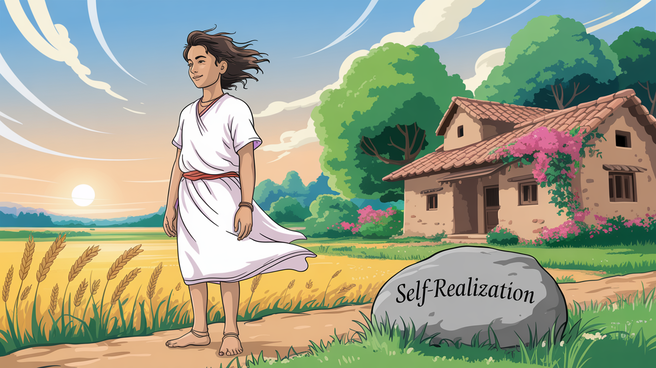 One of the most important lessons Yogananda’s life teaches us is to live with a purpose. He encountered numerous personal problems, such as illness, racism in America, and always lack of money, but never abandoned his goal of introducing yoga to the West.
Self-realization is very powerful. One evening, a man returning from a lecture in New York approached Yogananda and said, “I came to laugh at you, but what you said made sense even to a materialistic skeptic like me.” Yogananda did not try to convert him. He simply smiled and replied, “Truth has a natural and attractive beauty. I am merely a messenger of Truth.”
He wrote that life requires an inner encounter for recalibration.
Conclusion
Rosenberg says that when Yogananda died in 1952 (at age 59), he did not decay as usual. He cheated death, and the people who prepared his funeral were astonished and said they had never seen anything like it. The fact that God preserved him in his body for a week after his physical death, is a testament to the true miracle of yoga.
People from all over the world have sought God and followed Yogananda’s teachings and have been drawn to his approach to self-realization. His writings were first published 75 years ago and still have a wide readership today. They also remind us all that reflection is a spiritual practice that we should pursue as an essential part of our daily lives.
Yogananda says that the lesson we can learn from this truly inspiring life is so crucial: that we can live a fuller, happier life rich in peace, and can cast aside our preconceived limits on what is possible. His tale shows that with the help of God, hard work, and determination, no task is insurmountable. Starting out on the spiritual path in India, this avowed popular meditation teacher habituated himself to one of the world’s most renowned Spiritual teacher.

Leave A Comment