

Lessons from “Breaking the Habit of Being Yourself” by Joe Dispenza
Have you ever had the experience of getting stuck in a routine like you are on autopilot? Dr. Joe Dispenza offers an interesting way of coming out of it in his book “Breaking the Habit of Being Yourself.” Here are some of the things that I learnt from this amazing book.
Lesson 1: What You Think Is What You Create
 Each of your thoughts produces a different response in your body. This is not just a notion without evidence but a scientific fact. The mind tends to mix imagination with reality.
Think of the last time you watched a horror movie. You became nervous like you were in danger, your heart beating fast, and you were tense. Even some of the scenes in the film made you jump. Now, in actuality, were you in any danger? Not. It was the result of your mind’s fabrication that you were witnessing.
Dr. Dispenza elucidates that when we think the same thoughts day in and day out, we develop the same chemistry in the brain and body, and this becomes a cycle over a period of time. Whenever we have a thought or feel an emotion, we end up doing the same things.
When somebody says, “I am always tired,” the result is rather unfortunate. The body starts creating the precise chemistry needed to experience fatigue, which supports the repetitive allegation.
Dr. Dispenza asserts that the brain can change its structure to change itself physically.
Lesson 2: Your Brain is Built to Change
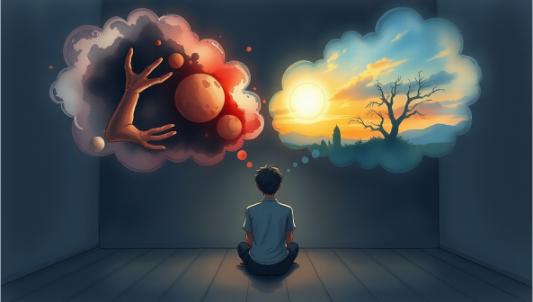 Neuroplasticity can be used to describe the development of new connections and pathways throughout an individual’s lifetime, and to understand the brain is not difficult.
When a thought is repeated many times, a particular course of neurons unique to the thought gets reinforced. This can be explained in the following manner: a walk in a tall field of grass. At the initial stage, it may be very challenging but after a few times, it becomes easier and easier to reach the destination.
One of my friend would tell me every time we met, “I am bad with names.” Of course, he could not remember the name of anyone. His brain had developed the mental shortcut heuristic of names that was so efficient that it was not even trying to memorize names. The fact that he got better once he was more conscious of the problem and tried out different methods of remembering names was nothing short of miraculous.
Lesson 3: You Are addicted to your Feelings
 This opened my eyes. Dr. Dispenza tells us that we can become chemically addicted to our emotional state. As an illustration, if you have been living a stressful life for a couple of years, your body would be accustomed to the stress hormones, and the cells would produce receptors waiting to receive the stress-related hormones.
When you dare to say change, your body goes through a kind of withdrawal of those emotional states. This was allegedly referred to as coined positive thinking patterns. When a person tries to think positively, he or she may experience discomfort, irritability, and anxiety. This unpleasantness makes many individuals give up and fall back to their familiar emotional habits.
Lesson 4: Your Reset Button Is Meditation
There are individuals who believe that meditation’s result and aim is relaxation. These people are unaware that relaxation is just a small component of a larger system because meditation is a powerful means of leaving one’s habitual way of thinking and reprogramming one’s brain’s circuitry.
Dr. Dispenza practices a specific type of meditation. This type of meditation enables you to realize the thoughts and feelings that you are experiencing at the unconscious level. When you identify such patterns, you will be able to make various decisions.
Until a few years back, the first thing that I did when I woke up was check my emails. This put me in a hyper-responsive and reactionary state which created more pressure on my mind even when I was still in bed. Through meditation I was able to point out this self-defeating habit and its effect. My mornings now begin with meditation, and that has significantly improved my day-to-day life.
In meditation, you are out of autopilot and establish a gap between stimulus and response. You temporarily stop reacting to the world. You are then at a crossroads where you can opt to take a different direction rather than walk the beaten track.
Lesson 5: What Happened Yesterday Is Not What Will Happen Tomorrow
 The majority of us live by the motto, “Same thoughts, same actions, same results.” We think that tomorrow will be the same as yesterday. But this is exactly what Dr. Dispenza attempts to disprove.
Your experiences have created neural networks in your brain in the past. Such networks influence how you view the world and what you consider possible. Nonetheless, they are not permanent.
My friend was brought up in a family with a scarcity mentality. These beliefs caused him to struggle uphill financially, despite his good job. The conditioned beliefs were not facts, as he had learned after using the techniques of Dispenza, but were worn neural pathways. As he mentally pictured zero-sum games and experienced much gratitude about the resources he currently had, he began to change his perspective on how to allocate resources.
The future can only be foreseen in the past when you are tied to a particular kind of thought and feeling. Change those, and you change the course of your future.
Lesson 6: Touch Your Future Now
 This is where things start to become even more interesting. According to Dr. Dispenza, in order to establish a new reality, the feelings related to the desired reality should be experienced before it comes to fruition.
Most people say, “I will be happy when I get that promotion,” or “I will feel safe when I have more money.” Irrespective of the motive behind the same, this way of thinking sets aside any positive feelings towards the future.
Instead, attempt to create whatever emotions you require at this moment with the help of meditation and visualizations. In the mind of your brain and body, imagining something is nearly the same as experiencing it. Thus, they will react similarly.
One of Dispenza’s students wanted to develop skills in public speaking. She would meditate and visualize how that confidence felt in her body. She thought of upright posture, articulate speech, and contact with the audience. By the time she was speaking later on, her body was already accustomed to the confident feelings due to the meditation.
Lesson 7: You Are Not What You Are
 History tends to be the source of self-definition: “I am shy,” “I have a bad temper,” “I am not good at math.” Although these statements can be perceived as unquestionable facts, their nature, being based on past events, makes them merely a product of the way of thinking programmed in our minds.
With the goal of improving our lives, Dr. Dispenza requests that we build a new identity that will transform us into the person we want to be rather than living as we have been and are.
My cousin has never considered himself to be athletic. He avoided sports and was uncomfortable when required to participate in them. He started doubting this self-identity after reading a book. Was he not athletic, or had he created a story he told himself? He began practicing a mild yoga program, walking, and then jogging. Now? Five years later, he has completed two marathons! The previous description of himself was not a fixed reality, but a product of patterns.
Lesson 8: Consistency Is a Key to Change
 Rewiring your brain needs to be done regularly. New habits require repetition to be reinforced considerably.
Think of driving. First, it required all your attention. Every step had to be thought out. After some time, driving became a habit. The same thing happens when we unlearn negative thought patterns.
Dr. Dispenza promotes the idea of practicing meditation every day. First, it can be senseless, inefficient, or awkward. You may even doubt its effectiveness. However, meditation will yield good results as time goes by and with practice. Your mind and impulses will start to change and alter slightly.
My friend Jake was interested in controlling his paroxysms of rage. He did a 60-day meditation challenge. In the first several weeks, he did not see much improvement. But after about 30 days, his wife said he was reacting in a less harsh way to their children’s sloppy behavior. Within 60 days, he was basically a changed person. The difference was that he was now consistent.
Lesson 9: The Habits of Your Surroundings
The people and environment you are associated with affect your habits and behaviors. This is why it is extremely hard to alter behavior in most instances.
If you desire a more positive attitude and you are surrounded with individuals with very pessimistic mindsets, you may be pulled back into your earlier negative thinking. Your environment’s physical setting comprises objects and people. These may influence short-term reactions, trigger thinking and behavior due to non-conscious stimuli, or initiate automatic responses.
A single man who attempted to quit this habit of negativity soon found out that he had one of the main triggers: his commute in the morning. He hated and got angry every day in the traffic. He could not change traffic, but he could change his response to it. Thus, he started to listen to motivational audiobooks on his drive to work. This little adjustment made his mornings different and more peaceful.
Connect with your environment differently. Why do you have your recurring unwanted thoughts? How can you change those triggers or your response to them?
Lesson 10: There Are Possibilities in the Unknown
The fear of the unknown paralyzes many people, but we attempt to get involved in more desirable routines that eventually lead us to getting into bad habits. Dr. Dispenza urges the adoption of the unknown as the realm of everything possible.
Your past is written in stone, and so is your projected future based on it. As predictable as it might be, you can transform your life by trying to do what you have never done before.
This type of change is not the easiest thing to accomplish. You would have to abandon the coziness of your usual emotions and ideas. But once you enter the feared uncertainty, the possibilities are endless.
After several years, a single lady started to figure out that she was dating the same unavailable man repeatedly. After following Dr. Dispenza’s techniques, she attempted the ‘unknown’ method. She stopped making any preemptive judgments, and instead of pursuing relationships that reflected her past, she found the beauty of spontaneity. That brought her to a different, better person, who she would have thought could never become her husband.
Conclusion
The new experiences we have not experienced are bound to scare some people only in comparison to the familiar. As long as they are approached with high emotions and curiosity, the so-called frightening experiences turn into excitement.
Breaking the known habits, which had been nurtured over the years, is not a small thing but the fruits of such an exercise can be life-changing. Jump in the potential that is untapped with the willingness and always practice and gradually the perception will change to a new reality. As Dr. Dispenza says, why be the person that you used to be, when you can transform into the person you would like to be?

Leave A Comment