

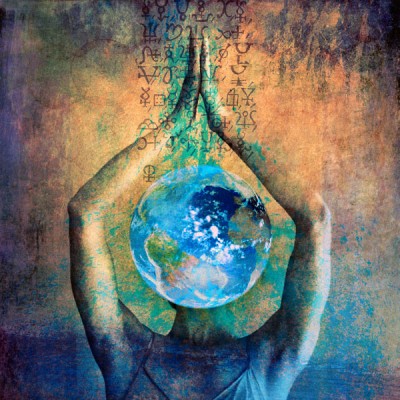
The subject of religion has as many beliefs, feelings, and perceptions around it as there are people on the planet. In a way, everyone has their own religion, even if they subscribe to a religion that many others do. This is because everyone has their own interpretations of the religion they subscribe to. If you were to ask followers of any given religion what their beliefs are, or what parts of the religion they agree or disagree with, they may each say something a little different from each other. Many people adopt the things they like in a particular religion, and ignore the things they don’t believe in, even if this is done on an unconscious level.
Metaphysics is emerging as a new religion or shall we say it is a very old religion that has been revived in the modern day. Metaphysics is a combination of many religions, old and new alike — particularly those that have Eastern philosophies, magical practices like alchemy, nature worship, and the belief that thought and emotion effect matter. You will learn much about this new “religion” called Metaphysics in your studies here at UMS, but this course in particular looks at other religions of the world in order to give you a solid background in understanding the beliefs of others in various systems. This could be useful in your work as a practitioner, healer, or teacher. Metaphysics tries to transcend the idea of religion, however, by all-encompassing ideas like letting go of “written in stone” beliefs that never change, realizing the self as a “part of God,” and seeing all beings as equals in spirit.
There do seem to be three beliefs that are common throughout all religions, no matter what culture they come from, no matter who founded the religion, and no matter who practices the religion. One of these beliefs is that there is a higher power that presides over the universe, the cosmos, human affairs, and the earth. This higher power is often called God in whatever language a person uses, and some believe that this higher power is some sort of force or presence that is within each sentient being on Earth and in the universe.
The second belief that seems to be common in every religion is the concept of “being a good person.” Some religions simply beseech the follower to do good deeds, take care of others, and practice right action. Others have deterrents in place that help the follower act more fastidiously, mainly the idea that there will be some sort of punishment for not “being a good person” or doing the right thing. For example, Christians call this “the final judgment” that happens upon death and the punishment is hell, or eternal damnation. Eastern philosophies call this karma, a type of punishment that happens in the next lifetime after the one where the bad deeds were done. The Golden Rule, “Do unto to others as you would have them do unto you,” is quite prominent in every religion. This does not necessarily mean that each religion sees “doing the right thing” the same way. There are great variances in this area.
The third commonality across all religions is the idea that rituals of some sort are necessary and have been incorporated into the styles of worship of that particular religion. All religions have rituals, whether they are incorporated through prayer, singing, group gatherings, or other ways of focusing intent on the divine.
A person’s religion is often a taboo subject in casual conversation. This is because it is difficult for those of differing religions to agree on many of the points that come up in discussions about religion. It is often joked, “Never discuss religion or politics if you don’t want to have a fight.” There have been many arguments, from mild to severe — the mildest being hurt feelings during and after discussions about religion, and the most severe being bloody and brutal wars over whose religion was the strongest, was to be adopted by all, and whose God was the true sovereign ruler of all life on Earth. One would think that something as sacred as religion could not possibly be the instigator of wars, but many feel so strongly about their religious beliefs that they want to make everyone a follower of their religion.
Of course, forcing others to adopt a religion in which they do not believe has never been a truly successful strategy; for as soon as the followers are released from the forced position, they return to the religion they loved previously. However, their children are often brought up with the religion and therefore adopt it as their own. This is how some religions were forcibly spread throughout the world.
Course Continued…
This is an excerpt from one of the 40 required bachelor’s courses offered in the University of Metaphysical Sciences metaphysical degree program.
The course World Religions is also available for individual purchase at our online store.
*Please note that courses purchased through metaphysicalsciencesstore.com are for personal interest only, and not as part of the degree program. If you are interested in pursuing your metaphysical degree, please fill out an enrollment form here.











Hi!
thanks for the written word as I’m deaf. I would like to be on all mailing lists. Thanks again.
Kenneth Wilson acnient.1@gmail.com
Thank you for your comment, Kenneth. UMS Offers all aspects of our program to deaf/hearing impaired. If you reply with your address I will send you out a hard copy catalog, and I will put you on mailing list.
Blessings!
Devon Love, UMS Advisor
Thanks for sharing the truth. I’m VERY hungry for more.
Let there be LOVE!!!
i am interested in studying metaphysics as it is applicable to all religions. how should i start? do i get credit for these courses. i already have a bachelor’s degree from the university of st. thomas in houston, tx. is it something which i could list on a resume. do i get official documentation that i have completed the course?
Thank you for your interest in University of Metaphysical Sciences! If you are interested in enrolling, the first steps are to choose a payment plan and then submit an enrollment form.
Regardless of previous education, all students begin the UMS program at the bachelor’s level. Our program is very unique, and so different from an academically based, secular process. Starting all students at the same place ensures all graduates have been exposed to all of the topics we cover.
You will receive each degree as you meet the requirements for that degree. You can learn more about the degrees and titles we offer here.
Our program is distance-learning only, and can be done completely online, though you do have the option of receiving your course materials in the mail in addition to the downloads.
Please feel free to reach out with any further questions by emailing ums@umsonline.org, or calling 707-822-2111.
Blessings!
Judy, UMS Advisor
i am interested in studying metaphysics as it is applicable to all religions. how should i start? do i get credit for these courses? i already have a bachelor’s degree from the university of st. thomas in houston, tx. is it something which i could list on a resume? do i get official documentation that i have completed the course?
i forgot to include question marks.
respectfully.
joshua evan mishler
Since our education is so unique, all students must start at the beginning, which isn’t hard, nor takes a long time. In that way we can be sure that all graduates have an equal education. Yes, you get official documentation, including a beautiful diploma for each level of education, Bachelors, Masters and Doctorate! You also get minister’s ordination and practitioner’s certificate.
are the courses done online? i live in houston, texas.
Yes! Everything is online, and you don’t have to show up for classes in person. However, we have optional free retreats during the year, feel free to see the schedule at http://www.FreeRetreats4all.com, although we aren’t doing any of those until the pandemic situation clears up more.