

Lessons from "Siddhartha: A Journey to Self-Discovery" by Hermann Hesse
Hello everyone, today I would like to introduce Hermann Hesse's insightful book, 'Siddhartha.' This book tells the story of a young man's quest to discover the meaning of life. You can learn many life lessons from this book. Let me introduce you to some of them.
Story Summary
 This story revolves around Siddhartha (meaning noble monk), a Brahmin who lived in ancient India. He had everything – respect, intelligence, beauty – but he felt strongly that something more than material things was lacking. So, he decided to leave his comfortable home with his friend Govinda and join a group of wandering saints called the Samanas.
Years later, after enduring hunger and doing meditation in the forest, Siddhartha concluded that denying himself more of material comfort would lead to better results. Then, he heard about his teacher, Gautama Buddha, and learned about him. While his friend Govinda decides to follow the Buddha, Siddhartha decides to forge his path.
Continuing from the previous part, Siddhartha takes a plunge into the opposite direction of life. He lives a life of luxury with the savvy businessman Kamala and the merchant Kamaswamy. He spends money lavishly, drinks heavily, and indulges in materialistic pursuits without thinking. Years of self-loathing or, at a minimum, months, Siddhartha completely changed his life.
One day while walking beside the river Siddhartha meets a humble boatman. Vasudeva, who takes lessons from the water with care. From the river he receives lasting peace and wisdom. Siddhartha too becomes a ferryman on the river helping people as they come along. Every day he learns one great lesson after another about living from the water itself.
Lesson 1: No one will guide you. It is your special journey.
 Siddhartha teaches that no one can guide you on the path to true satisfaction. Everyone can find that path within themselves. With deep and sincere respect for the Buddha, Siddhartha decides to break away from him, saying, "I must find my own path."
Now consider this approach: 'Paris is beautiful' is just a single phrase complete with information. Paris reveals its beauty in the streets. For book lovers, reading a book about the path to enlightenment is like reading about Paris. But actually experiencing the path, seeing it in person, is another level of experience!
I remember a friend telling me to go to medical school, saying, "It will be good for you" But I knew what was best for me, and Siddhartha taught us that. It's okay to learn from others, but you have to learn for yourself.
Lesson 2: Balance is better than extremes
To live as a self-denying Samana or as a trader is both very bad. You must find peace in the middle path, which consists of living simply without being too strict.
It's like going on a strict diet and then overeating fast food. Neither extreme leads to health; instead, it requires consistent and sustainable habits.
This lesson is true in many aspects of life. Working 80 hours a week sounds like a path to success, but going to the other extreme does nothing but lead to miserable unhappiness. In career, taking unplanned breaks while engaging in meaningful work is often the best option.
Lesson 3: Wisdom Takes Time
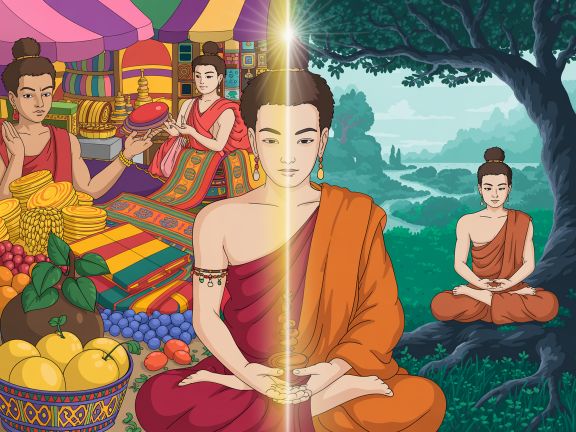 Contrary to popular belief, Siddhartha's enlightenment was the culmination of a lifetime of experience, numerous mistakes, and years of profound reflection and introspection.
Today's society rekindles the desire for instant gratification. But self-improvement is not driven by this desire. The same goes for learning to play the guitar. You can't cut your practice time short enough to make your fingers hurt. And when you start a business, there's no way to avoid years of skill acquisition and uncertainty.
I once tried to join a meditation retreat to learn over the weekend. I intended to do some mindfulness exercises over the weekend, but failed completely since my thoughts wouldn't quiet down. So I realized that wisdom is not a one-off gift, but rather a result of how much time is spent to learn.
Lesson 4: Talk Less, Listen More
Here, it's more about those around you than about you. Once Siddhartha meets Vasudeva while traveling before dawn in the next morning. This boatman is very good at observing the river and the folks who live around its banks. From observing Vasudeva, Siddhartha learns that talking and seeing are not as important as listening.
The river is silent, that's why it makes Siddhartha learn the most important lesson. Let things go with the stream and you'll be least likely to come to grief. Siddhartha learns from watching how the water trickles through cracks and how the water speaks to him.
One of my former bosses had the habit that after I had finished speaking, he would sit there quietly for a moment. At first, this didn't make sense, and I felt rather embarrassed, but later, I found out that my words were meaningful to him. It wasn't because he was drawing his words out, but rather that he listened carefully and used all his mental faculties to do it. Because of this, his decisions were much better.
Lesson 5: Everything is Connected
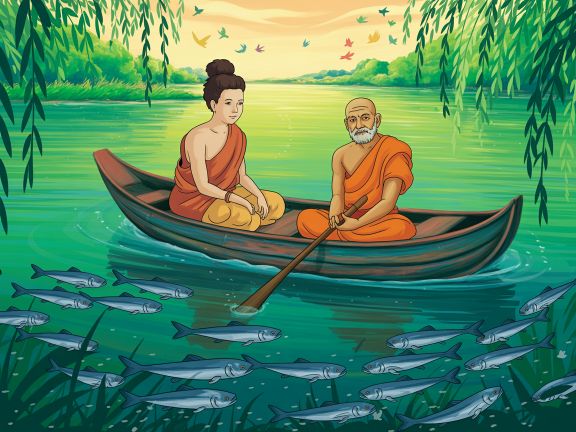 Siddhartha sat listening to the river and realized the interconnectedness of all things. Now I see. Water from the sky passes through every corner of the earth, rises to the sky in the form of vapor, becomes cloud, and the clouds returns back to the earth as rain. In other words, what we call heaven, is this completely transformative activity of changing things into other things in the human world.
The idea suggests that all distinctions of space or time, between man and woman, are fictitious. When you are looking at the river through Siddhartha's eyes, then time does not have that kind of continuity. All timelines are happening in the present all at the same time.
Consider the choices you have made in the past and how they have caused you to become what you are today. Also, think about the things that you are now doing, and how they will shape who you become tomorrow.
Lesson 6: You Can't Run from Suffering
Siddhartha has a feeling of abandonment as his son tries to go away from home, and a feeling of attachment when he discovers his son's existence. He tails after the kid and will not release his grip; finally, however, he accepts fate and moves on.
This explains that pain is an inevitable element intrinsically to exist by itself. To flee from what one feels or stare down the truth does not make matters easier; it just makes things more difficult. The first step toward recovery is always acceptance.
One thing I remember in particular is trying to avoid difficult conversations with specific individuals. Doing so only makes a situation worse and worse. Eventually, like Siddhartha, I realized that when faced with a challenge, it is best to confront it rather than avoid it.
Lesson 7: Experience is more important than knowledge
 Siddhartha knows the difference between knowing a lot and knowing how to use it. He says, "You can't pass on wisdom, but you can pass on knowledge."
It's like the difference between reading about swimming and actually doing it. All day long, people can study different styles of swimming. If you've never felt what it's like to float in water, on the other hand, your practical understanding will be only the theoretical part and a few parts in between.
When my friend told me what it was like to perform in front of an audience, I listened carefully. But when I was standing on the stage facing a crowd and my heart raced, it hit me like a thunderbolt. His words had not been meant to prepare me for what lay ahead…
Lesson 8: Love Turns Everything Upside Down. This can be true.
Siddhartha is an enlightened and emotionally detached father. But his father's pure love teaches us that wisdom is about more than the mind; it's a matter of the heart.
Love is a many-splendored thing, painful and confusing, sometimes gloriously messy and wrenchingly emotional, but it is also necessary. Siddhartha's love for his son is painful, but it also makes him more fully human.
I've met people who seemed to have their lives all figured out until they fell in love or had kids. All their theories of dreamy detachment suddenly stand revealed as empty.
Lesson 9: This Moment is All There Is
Siddhartha learns that a preoccupation with the past or the future can hinder one's ability to live in the present moment. The calm he at last achieves can come only through his utter destruction of every instant other than this very instant.
The river enlightens him to the fact that time isn't a straight line but a circle. The only door to this existence is to enter the present moment.
Have you ever been so engrossed in something that you didn't even realize you lost track of time, like a song, a piece of art, or an excellent conversation? It was in that kind of absorption that Siddhartha solved the riddle of life.
Lesson 10: We Are All Seeking
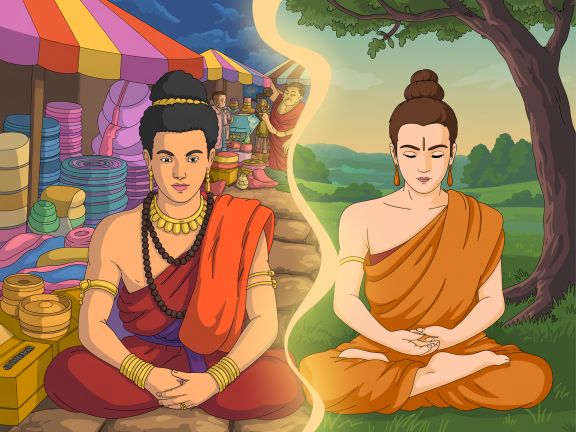 At the end of the story, Govinda, Siddhartha's old friend, leaves in search of what he has been looking for all along: he has followed all the teachers and their teachings. He begs Siddhartha for some wisdom. Siddhartha requests him to go into silence and look deeply; as he explains the simple story of the things that are happening together.
The basic human fact is that we all seek meaning, we all want to connect, and we all want peace. Some look for it through religion, as a career, in romantic relationships, or as "stuff," and so on. Whichever way you go and wherever you stop, you're thirsty.
I find this comforting. As we embark on our quest to discover what's important, it's good to remind ourselves that life is complex indeed, it was meant to be complex and that complexity is a natural byproduct of being human.
What We Hear in the Sculptor's Testimony about Siddhartha
The extraordinary thing about this story is that it is nearly a century old and set in ancient India, yet the lessons it teaches are timeless. Perhaps more than at any other time in our fast-changing, complex, overwhelming, and noisy world.
Siddhartha says for us to sit in silence and hear the whisperings of our soul, we need to still the mind, step at a human pace, practice deep listening, find your way, accept joy with the same readiness as sorrow, and recognize that you are connected to you, everyone and everything else.
His quest teaches us that the answers we seek are received by not following obediently in the path of others, in amassing travel souvenirs, or even in scripture. The journey teaches that answers come when you live fully and when you shift gears, make mistakes, fall further in love, honor life, and keep a watchful eye on the river of life that runs within and outside of us.
Remember Siddhartha on the riverbank the next time you feel stuck or blocked. Don't feel blocked; go inside and be unsure of yourself for a change. And you might even find it rewarding in itself!















Leave A Comment