

Breathwork Practices for Expanding Conscious Awareness
How many times has someone told you to just breathe through a stressful episode? It sounds almost too simple to take seriously… until you try it and realize how quickly your state can shift. At some point, breathwork stops being a tool for calming down. Rather, it turns into a way to observe yourself more clearly, regulate your internal state on demand, and access levels of awareness that most people move through life without ever noticing. That said, today we’ll be talking about breathwork practices for expanding conscious awareness and how to actually use them in real life.
Why breathwork works
Most people come to breathwork because something feels off. Too much mental noise. Too much tension in the body. Way too many thoughts running at once.
And that’s not surprising, given the connection between breathing and the nervous system. It then only makes sense that if you change how you breathe, you change how your body responds to stress.
Many people start breathing more consciously because of the stress in the first place… only to realize there’s more to it than meets the eye. Namely, breath-focused practices are closely related to mindfulness techniques used for anxiety relief, which is also why they’re often recommended as a powerful way to calm the mind. These approaches all work on the same principle: by anchoring attention to the present moment and regulating the nervous system, they help you feel less overwhelmed and create mental space. With that newfound place, something else becomes possible – a greater awareness, sharper focus, along with a deeper connection between body and mind.
What expanding conscious awareness actually means
Expanding conscious awareness doesn’t mean anything mystical (unless you want it to). At its core, it means:
- Noticing your thoughts instead of getting pulled into them
- Feeling your body instead of ignoring it
- Recognizing emotional patterns in real time
- Being able to shift your state intentionally
Most people operate on autopilot. Breathwork interrupts that. It slows things down just enough for you to see what’s happening internally, which is precisely where awareness starts to expand.

Conscious breathing doesn’t let your mind wander. It brings you back to your present self.
Breathwork practices for expanding conscious awareness
With all said and done, it’s time we got to the practical side of things, a.k.a. the actual practices you can follow in your day-to-day.
1. Box breathing
Box breathing is simple, structured, and incredibly effective at bringing your attention back under control.
To practice is:
- Inhale for 4 seconds
- Hold for 4 seconds
- Exhale for 4 seconds
- Hold for 4 seconds
- Repeat for 3-5 minutes
Box breathing works primarily because of the structure it provides. This structure gives your mind something to focus on, so rather than jumping back and forth between thoughts, your attention locks into a rhythm.
This is one of the fastest ways to:
- Reduce mental noise
- Stabilize your nervous system
- Create a baseline for deeper practices
2. Diaphragmatic breathing
We tend to breathe shallowly without even realizing. This is a problem because chest breathing keeps us in a mild state of stress.
The only way to get out of that state? It’s to breathe from your diaphragm. At first, consciously, before you start doing it naturally.
To do so:
- Put one palm near your heart, the other on your belly
- Inhale slowly through your nose, expanding your stomach
- Keep your chest relatively still
- Exhale slowly
- Continue for 5-10 minutes
This type of breathing:
- Activates the parasympathetic nervous system
- Reduces physical tension
- Bring your awareness into the body
The latter is especially important because you can’t expand awareness if you’re disconnected from your body.

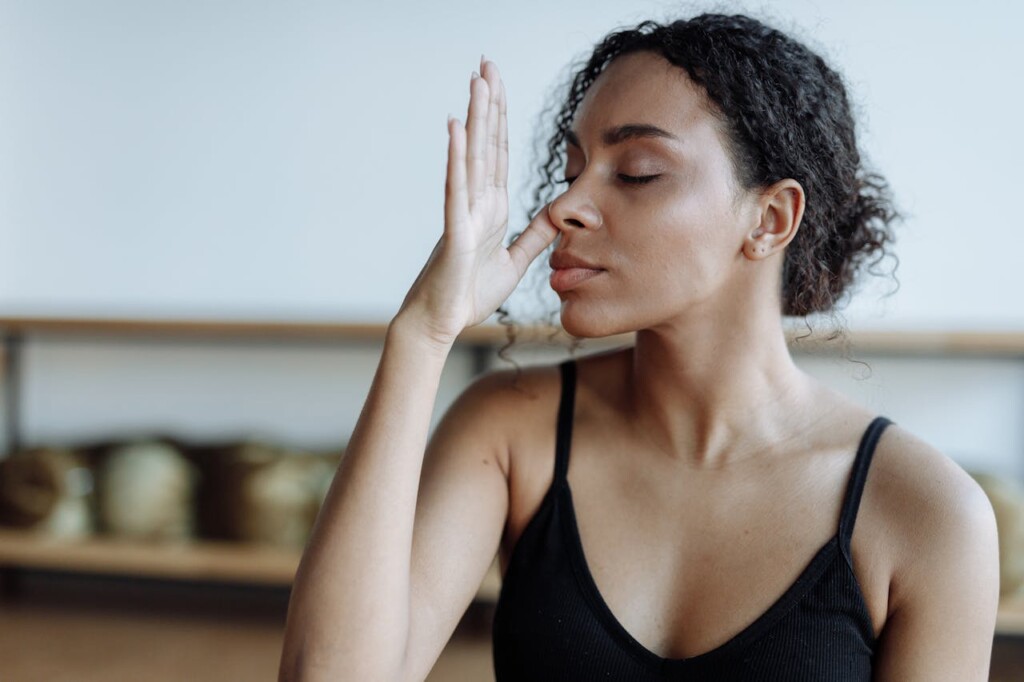
Alternate nostril breathing is considered one of the best breathwork practices for expanding conscious awareness.
3. Alternate nostril breathing
Alternate nostril breathing is known for balancing mental energy and improving focus.
To breathe this way:
- Close your right nostril, inhale through the left
- Close the left nostril, exhale through the right one
- Inhale through your right nostril
- Close it, exhale through the left
- Continue for a few minutes
Why does it help, though? Because this pattern forces your attention to stay rather than shift onto something else a couple of seconds later. Clinicians suggest that the average attention span has dropped to around 47 seconds in the last couple of years, compared to the previously measured 75 seconds. Some sources suggest it’s even as low as 8 seconds, shorter than that of a goldfish! Regardless, alternate nostril breathing allows you to retain focus for much longer. On top of that, it also reduces mental fog, improves concentration, and creates a noticeable sense of calm clarity.
4. 4-7-8 breathing
Some breathwork practices are gradual.
This one isn’t.
4-7-8 breathing is designed to shift your state fast, in particular if you’re anxious or overstimulated.
To practice it:
- Inhale for 4 seconds
- Hold for 7 seconds
- Exhale slowly for 8 seconds
- Repeat 4-6 times
Afterwards, you’ll notice:
- Your heart rate is slowing down
- Your thoughts are becoming less intense
- Your body is releasing tension
It’s a practical tool when awareness feels out of reach because your system is overloaded.
5. Conscious connected breathing for deeper awareness
Conscious connected breathing removes pauses between breaths, creating a continuous flow.
How it works:
- Inhale deeply
- Exhale without force
- Move directly into the next inhale (no pause)
- Maintain a steady rhythm between 5 and 20 minutes at a time
This type of breathing can:
- Surface suppressed thoughts or emotions
- Increase internal awareness
- Create a heightened sense of presence
It’s more intense than the other techniques, which is exactly the point. It’s not used to calm down, but explore what’s hiding deep below.
6. Breath observation
This one isn’t one of the breathwork practices for expanding conscious awareness in a traditional sense. As its name suggests, it’s a form of observation.
It’s all about noticing the way you breathe naturally as you sit or lie down without changing it.
This practice trains pure awareness because you’re not controlling anything but watching. That part is where most people struggle.
Because the moment you release control, you start noticing:
- If your mind is restless
- How quickly your attention goes to something else
- How automatic your thoughts are
What changes when you stick with breathwork
At first, you’ll notice small things:
- You react less impulsively
- Your thoughts slow down
- You feel more in control of your state
Then, it goes further.
You start catching patterns of recurring thoughts, emotional triggers, and even physical tension you didn’t notice before.
And eventually, you develop something most people don’t have: the ability to step back from your experience whilst you’re still in it.
That’s conscious awareness. Not escaping reality but seeing it clearly.
Breathwork isn’t the goal but the gateway
It’s easy to treat breathwork as just another habit. Something you do for a few minutes a day to feel better. But it’s much more than that. Breathwork practices for expanding conscious awareness are a way to understand how your mind works, regulate your internal state, and access awareness levels you never knew existed. The best part is, you already have everything you need to do it. So, why not use that to your advantage?
Source:
https://www.apa.org/news/podcasts/speaking-of-psychology/attention-spans
Photos used:
https://www.pexels.com/photo/woman-in-black-tank-top-meditating-6958256/
https://www.pexels.com/photo/a-woman-doing-nostril-breathing-6648567/
https://unsplash.com/photos/a-woman-sitting-on-the-floor-with-a-laptop-vFefVZLzQYU















Leave A Comment