

How Meditation Can Take You From a Scattered Mind to a Steady One
 Imagine this: a little Bengali lad is sitting motionless with his eyes fixed on a flickering fire. Even a poisonous cobra near him cannot break his concentration. But this was not a fictional story; this was a childhood practice of contemplation of Swami Vivekananda. That same ability to focus within would later make him one of the most potent spiritual teachers in history.
He did not only meditate; he transformed the way the world perceived meditation. Through his teachings, he built a bridge between Eastern wisdom and Western minds. Why is this approach so convincing? What are the riches that modern seekers can find in this meditative approach? This article is greatly inspired from the teachings of Swami Vivekananda and other spiritual teachers.
The Foundation: Knowing the Real Nature of Meditation
Meditation was not about just sitting down. It was the ultimate unifier. It is the bridge linking the human soul to God. It is like a telephone connection between your daily consciousness and something infinitely more.
The definition was admirably simple: When the mind learns to stay fixed on one thing, inside or outside, it starts flowing towards that thing in one continuous stream. Think of the water flowing through a channel, and there are no obstructions to it; that is what is meant about our mental processes.
But this is where the teaching gets interesting. Meditation is the best aid to spiritual life. Why? Because at such a time, we are lifted beyond material restrictions altogether. We live our true self free of the body and the mind.
The Three-Stage Journey: Scattered to Sacred
There is a gradual path that even a novice can understand. There are three different stages through which practitioners go:
Dharana (Concentration): The first step is to concentrate on one thing, e.g., a candle flame, a religious symbol, or even a glass on your table. In the beginning, your mind will be wandering all the time. Of course, that is normal! It is like balancing a wobbly bicycle; it requires practice.
Dhyana (Meditation): This is where it gets interesting. The mind is made steadier, less easily distracted. You are no longer struggling against wandering thoughts but are flowing in the direction you have chosen to focus on. It is as though there is a difference between an upstream journey and a journey with the current.
Samadhi (Absorption): The final place. In this state of exception, the distinction between the observer and the observed is erased. You do not merely look into the candle flame, you are the flame. This is when the mind and the glass are the same.
Practical Techniques: Time-Tested Techniques
The Foundation: Good Posture
To begin with, sit right! The teaching stressed this: “Sit in the posture in which you can sit still for a long time”. However, this is where the ingenious idea lies: your spine is not supposed to carry the weight of your body. Why? Since all the nerve currents pass through the spinal column, any pressure would disturb their natural course.
Consider your spine to be a sensitive highway of spiritual energy. Would you put heavy obstacles on a busy road?
The Lotus Visualization
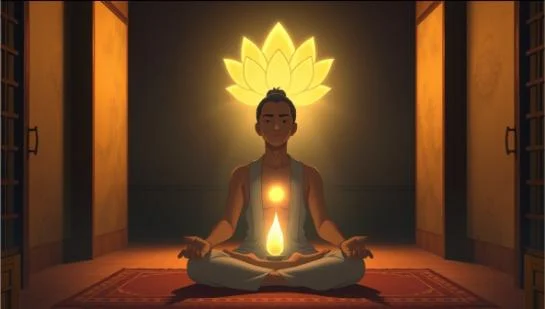
Among the most popular methods is the visualization of a radiant lotus flower growing out of your head. It is an image of virtue in the middle, knowledge in the stalk, and eight petals of various spiritual powers. Look at this flower of light and you will feel the presence of God, wrapped in bright light.
This is not just fantasy. Visualization techniques help your mind concentrate and connect you with higher ideas. They are a kind of mental gymnastics that builds up your thinking muscles.
The Heart Flame Technique
This is another effective method: imagine a place in your heart where a holy fire is always burning. Imagine this flame as your soul, and in that flame, try to see another light, a brighter light, the Supreme Soul, and that’s the God within you.
This method does something extraordinary. Rather than trying to find the Divine somewhere away, you see it is within yourself. That will be a new way of thinking.
The Gaze Technique
There is also a more basic one: “Sit straight, and look at the tip of your nose.” This may seem strange, but there is great wisdom in this. By dominating your optical nerves, you are already on the way to mastering your whole nervous system and willpower.
The Transformative Power: What Meditation Does to You?
Mental Purification
Holy meditation assists in burning all impurities of the mind. Imagine your mind as a messy room, full of things you do not need, worries, resentments, petty desires, etc. Meditation is a kind of fire that burns everything that is not needed, leaving only what is really important.
The Ultimate Rest and Restoration
Even the deepest sleep will not bring you such rest as meditation. In periods of intense contemplation, your brain activity practically ceases, which gives you unprecedented rest. You may even get so engrossed that physical feelings will be lost altogether.
Expanded Consciousness
Most importantly, though, regular training expands consciousness beyond its usual limits. By meditating, one could enter into other levels of consciousness, and in some cases, one might see disembodied spirits or see the spiritual world that is usually invisible.
Contemporary neuroscience is supporting more and more the idea that contemplative practices can lead to altered states of consciousness and heighten perception.

The Common Obstacles and Honest Insights
Even spiritual masters have problems! One honest confession is this: “As soon as I sit down to meditate, the filthiest of the world appears. The entire situation is sickening.”
The mind tends to revolt against stillness. It is like a naughty child who makes tantrums when told to sit down. Meditation becomes easier with more and more practice.
The Negative Approach: Decluttering the Mind
It is recommended to start with negative meditation. Before adding new thoughts, you should first eliminate the existing ones. Think all away. Examine all that comes to mind by the mere movement of the will.
This method is like archaeological excavation. You peel off layers of mental debris until you get to the treasure trove beneath, your true Self. Only when you have cleared this psychological rubble can you say with authority what we really are: existence, knowledge, and bliss.
The Final Destination: Union and Self-Realization
Where does this reflective journey lead us to? It leads to the unification of the subject and object. The subject of meditation and the object of meditation merge into a single reality.
It is not philosophical abstraction; it is an experience that changes everything. Once you understand the unity behind the seeming diversity, life is a constant celebration, not a struggle.
Daily Life Integration: Off Meditation Cushion
Meditation was never meant to be left in seclusion from daily life. Practitioners are urged to bring contemplative awareness to every activity. Day and night, think and meditate on Brahman, and it is not impossible that even amid worldly activity, we may have a background of spiritual awareness.
This combination brings about a composite culture of knowledge, work, love, and a meditated mind. We do not need to separate our spirituality but integrate it into our current life.
Conclusion: Ancient Wisdom Never Goes Out of Date
These meditative writings offer practical ways to inner transformation. Our focus on spiritual understanding and thoughts is more essential than ever in our hyper connected, attention-fragmented world.
Complex philosophies won’t help as much as practicing these techniques regularly. These techniques have something to offer whether you are a cynical amateur or a long-time practitioner. The child who fearlessly meditated beside a cobra became a teacher whose wisdom still enlightens millions of people.
The power of meditation leads us to everything. It may be time to find out what everything means to you. And, indeed, as the teaching observed, “The best thing is meditation.” Why not start that best thing today?














Leave A Comment